On Halloween night, drive slower than the limit in neighborhoods, especially from 5 to 9 pm, and expect children to step out between parked cars without looking. More children walk the streets that evening than any other night of the year, many in dark costumes and masks that limit what they see.
The rules don't change on Halloween, but where the people are does. Here's how to adjust.
Before you go
- Put the phone away and set your route before you start.
- Turn headlights on early, even at dusk, so children can see you.
- Avoid neighborhood streets at peak trick-or-treat time if you can take a main road instead.
In neighborhoods
- Slow down. At 20 mph you can stop far shorter than at 30.
- Watch the curbs and the spaces between parked cars. Children dart out from there.
- Expect groups to cross mid-block, not at the corner.
- Enter and back out of driveways slowly, and look behind the car before you move.
- Yield to everyone on foot, in a crosswalk or not.
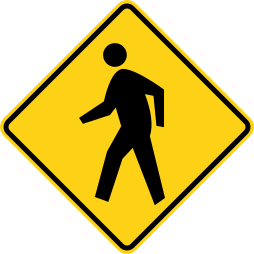 Pedestrian CrossingMUTCD W11-2
 SchoolMUTCD S1-1
If you're driving the trick-or-treaters
Let children out on the curb side, never into traffic. Park legally and turn your hazard lights on while you wait. Remind older kids who walk alone to cross at corners and use a flashlight.
If you're a new driver
Halloween is a good night to stay off the road, or to drive with a parent. It combines darkness, crowds, costumes that hide faces and excited children who don't look, which is exactly the kind of evening where experience matters most.
Why speed matters so much
Stopping distance grows fast with speed. At 25 mph a car needs around 85 feet to stop on dry pavement, including the time it takes to react; at 35 mph, around 135 feet. A child who steps out 100 feet ahead is safe at the first speed and not at the second. See the three-second rule for why reaction time matters.
To feel the difference, try the stopping distance game: guess where a car stops at different speeds, then watch.
Practice seeing it coming
Hazard Watch trains the exact skill Halloween needs: noticing the ball before the child.
Spot developing hazards in Hazard WatchStart ›The rule behind it: people in the crosswalk go first.