Road Sign Shapes and Colors
A sign's shape and color tell you what kind of message it is before you are close enough to read it. That is why the permit test asks about them.
Shapes
 OctagonStop. No other sign uses this shape.Example: STOP
 Downward triangleYield: slow down and give the right-of-way.Example: YIELD
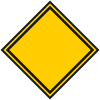 DiamondWarning of a condition or hazard ahead.Example: Curve, Merge
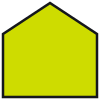 PentagonSchool zone or school crossing.Example: School
 CircleRailroad crossing ahead.Example: Railroad advance warning
 CrossbuckRailroad crossing: yield to trains.Example: Railroad Crossing
 PennantStart of a no-passing zone.Example: No Passing Zone
 Vertical rectangleUsually a rule you must obey.Example: Speed Limit
Colors
RedStop, yield, or not allowed.
WhiteA rule (regulation).
YellowGeneral warning.
Fluorescent yellow-greenSchool, pedestrian or bicycle warning.
OrangeTemporary traffic control: work zones.
GreenDirections and guidance.
BlueMotorist services.
BrownRecreation and cultural sites.
BlackA rule, such as One Way.
PurpleLanes for electronic toll accounts only.
Coral and light blue are reserved in the MUTCD for future uses.
Shape-only quiz: no words, no symbols
Question 1 of 8Shapes
A sign with this shape and nothing on it means…
Tip: press 1–4 to answer.
Questions people ask
What does a yellow diamond sign mean?
It warns you about something ahead: a curve, a merge, a crossing, a signal or a road condition. Slow down and look for what it describes.
Why is the stop sign the only octagon?
So drivers can recognize it from any angle, even from behind or covered in snow. The same idea makes yield the only downward triangle.
What is the difference between yellow and fluorescent yellow-green?
Both are warnings. Fluorescent yellow-green is used for school, pedestrian and bicycle signs so they stand out more.
What do orange signs mean?
Temporary traffic control, usually a work zone: road work, detours, lane closures or flaggers ahead.